Opening times
The church is usually open from 9am until 5pm daily and anyone is welcome to visit for a few moments of quiet or prayer, or simply to have a look around. Mid-week and Sunday services, as well as occasional concerts and events, also take place in church during these times. See the website events listing for details.
The church is closed on Bank Holidays.
Our history
The early years
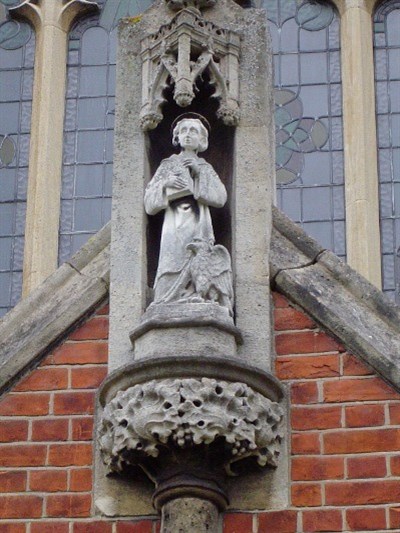 The church of St John the Evangelist was founded in 1891 as the daughter church of St Andrew's Church, Cherry Hinton, as the Cambridge residential area extended south of the city into the land between Hills Road and Cherry Hinton Road. In the early days, with neither building nor clergy, the congregation met in Homerton College (then called Cavendish College), and services were normally led by local clergy or chaplains from the University colleges.
A committee drawn from the local community and the University of Cambridge, under the chair of the Master of Peterhouse, raised funds for a building. The first building on the plot was a small wooden schoolroom erected for use as a Sunday School. In 1893 a retired clergyman, the Reverend John George, offered to serve as curate-in-change on a voluntary basis and played a significant role; he and his wife donated the pulpit to mark their silver wedding anniversary.
By May 1896 the fund-raising enabled the laying of the foundation stone, and by the end of that year the eastern half of the present building had been completed, with the west end blocked off before the extension was built by a wall of yellow Cambridge bricks. The church was consecrated in 1896, the first stage of the church building was usable by the end of 1897, and Rev George became St John's first vicar in 1897 and served until 1903.
The second vicar, Reverend Love, served 11 years (1903–1914), and oversaw the building of the the choir and clergy vestries (1909).
The Great War and the Second World War
He was followed by Reverend Jackson (1914–1927), who oversaw the building of the Parish Hall on the corner of Blinco Grove and Baldock Way, which served as the base for the Sunday School. This period overlapped the tragedy of Great War, which saw the death of 45 parishioners in service in the armed forces. In spite of the war, efforts to raise funds for the building of the church continued, and it was possible to complete the extension of the west half of the church in 1929 during the priesthood of Reverend Patterson Morgan (1927–1938). The tragedy of the Second World War occurred during the priesthood of Reverend Robert Jary (1938–1947), and the church served the local community and the forces in a number of ways.
The post-war years
A period of consolidation of parish work, particularly with young people, followed during the priesthoods of Reverend John Needham (1947–1955) during which time the organ was installed, and Canon Frederick Stanbury (1956–1974). During the priesthood of Canon Frederick Wilkinson (1975–1988) a new parish room was built on the South side of the church, which was extended during the time of his successor, Canon Brian Jones (1989–1997). This marked the end of the building of the church. Canons David Reindorp (1997–2006) and Susan Wyatt (2006–2016) subsequently led St John's in further establishing the work of St John's in the local area.
Notable individuals who have been involved in St John's
Over the years St John's has been fortunate to have had a number of wonderful incumbents, curates, honorary priests, churchwardens and other church officers. Some of these have gained national attention. One curate, Stephen Sykes (1985–2006) was Regius Professor of Divinity at the University of Cambridge, and subsequently served as Bishop of Ely. Before being ordained as Vicar of St Bene't's in Cambridge, the Reverend Angela Tilby served as honorary priest from 1997–2006; Angela is well-known for her work on BBC Radio 4, particularly as a regular contributor to Thought for the Day and the Morning Service. A previous vicar, Reverend Canon David Reindorp, was chaplain on the television series Lad's Army and other reality-tv programmes.
The Museum of Cambridge's Capturing Cambridge has archive material from St John's which includes historical photos, articles about Cambridge history published in the parish magazines, information about parish residents on the St John's roll of honour for World War Two, and parish residents who were Red Cross volunteers in the Great War.
View some interesting photographs and articles from our history here: